
Hunova
A dual robotic platform (sitting + standing) for trunk and balance rehabilitation.
In partnership with Movendo Technology
Hunova
A dual robotic platform (sitting + standing) for trunk and balance rehabilitation.
In partnership with Movendo Technology
Principles – Motor control

Trunk control, an essential link for walking
From static balance to dynamic balance
During gait rehabilitation, trunk statics are an essential link. A significant number of patients retain deficits in trunk control upon returning home and are subject to a risk of falling.
Although it relies on automatic motor patterns, walking is a complex activity. There is a strong correlation between trunk control and strength, the maintenance of balance, and gait.
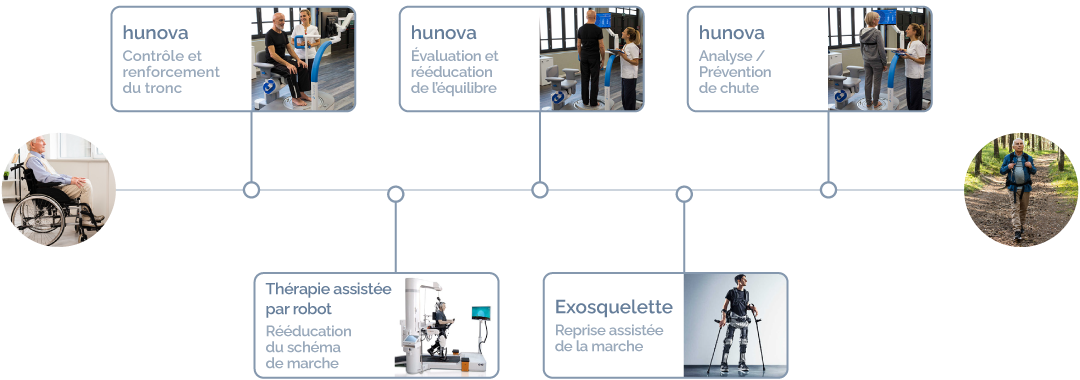
It is therefore necessary to build a progressive care pathway from the acute phase until the return home, based on :
- Deep trunk muscle strengthening in a sitting position.
- Standing static balance.
- L’équilibre dynamique.
- Assisted walking.
- Functional independence (and its measurement).
Immobilization and the loss of representation of balance and gait patterns.
Patients thus present a deficit in the representation of balance and gait patterns, which significantly impacts their autonomy and quality of life.
Early intervention, intensity, and the diversity of rehabilitation exercises are essential conditions for offering each patient the maximum chance of recovery.
Études Bed Rest : KORTEBEIN et al., 2008; SELINA et al., 2015; RESCHKE et al., 2009; SAUMUR et al.,2020
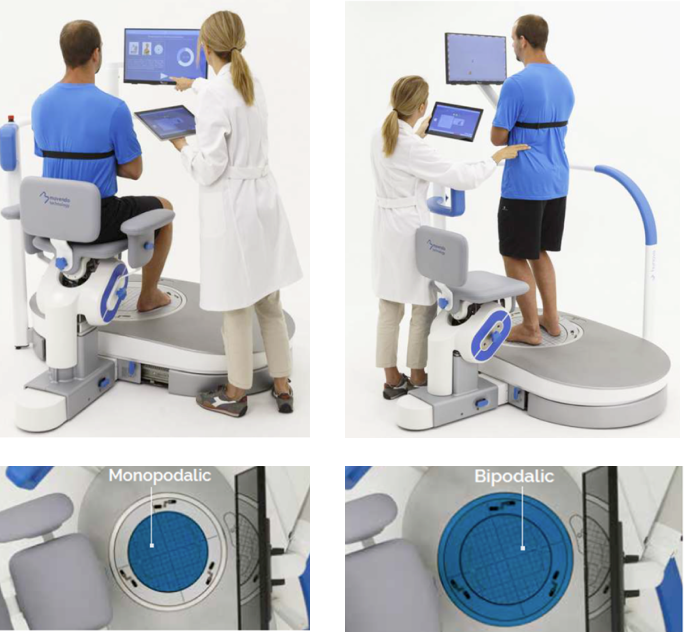
A dual robotic platform: sitting + standing
Developed at the renowned Italian Institute of Technology, the Hunova device is a dual robotic platform dedicated to the evaluation of balance disorders, trunk muscle strengthening, and gait rehabilitation.
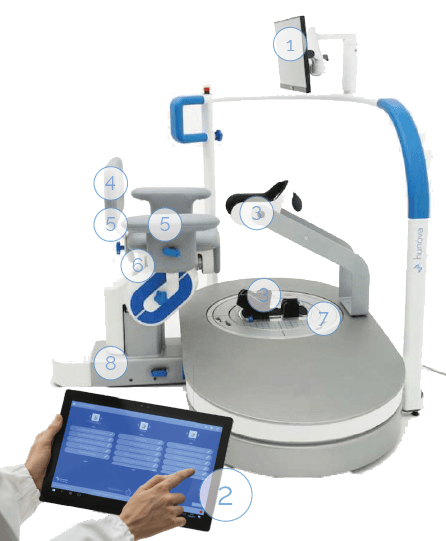
- Adjustable touchscreen
- Hunova device remote control tablet
- Knee sensor & ankle support
- Wireless position sensor
- Adjustable armrests and backrest
- Robotic sensory seat
- Single or dual-foot platform with force and position sensors.
- 3D adjustable seat position
A unique technology for balance and trunk rehabilitation
Adapt and personalize the protocol
- STATIC: the patient stands on an immobile surface, either flat or inclined.
- ACTIVE: the patient performs active balance exercises, and Hunova provides programmable resistance (elastic, fluid, free, or counter-resistance).
- PASSIVE: Hunova creates instability via the platform (continuous displacement or impulses).
- ASSISTED: the embedded AI assists and guides the patient to reach targets and perform exercises.
Discover the Hunova device on video

Discover hunova
on video

A complementarity of tools
- an improvement in the strength of the trunk and lower limb muscles;
- an improvement in sitting and standing balance;
- a reduction in asymmetries;
- an improvement in mobility and range of motion;
- a reduction in the risk of falling;
- a gradual and progressive return to walking;
- an improvement in daily activities.
The fields of care

Neurology

Rachis

Orthopedics
Geriatrics

Sports Rehabilitation
Hunova enables care plans tailored to each patient’s abilities and can be utilized across a wide variety of treatment goals.
Hunova, a 360° device
A comprehensive approach
- Fine and precise stimulation through AI-controlled robotic platforms
- A software platform that integrates a variety of protocols tailored to each patient and pathology.
- Precise and playful feedback integrating pressure points and trunk position.
- The integration of upper limb motor skills and dual-task training.
- Simple, fast, and secure patient installation (patient transfer).
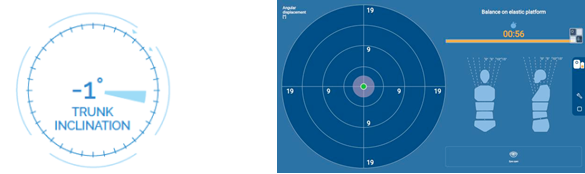
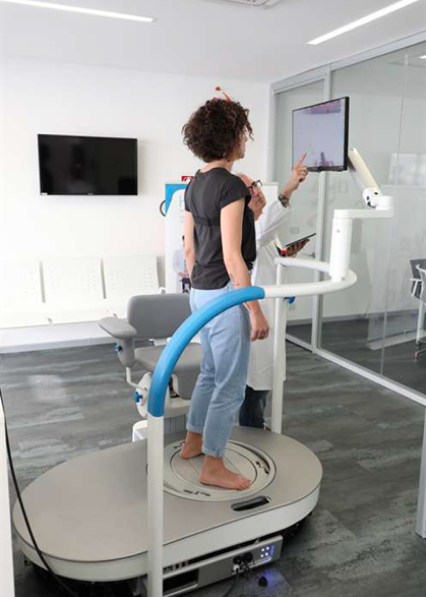
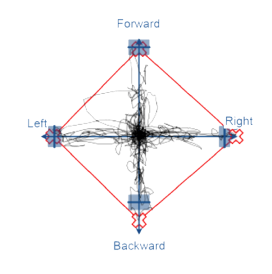
Assessments and indexes to monitor patient progress.
In particular, the Silver Index is the first robotic tool dedicated to the assessment and prevention of falls in geriatric patients.
The Artificial Intelligence integrated into this Silver Index provides, in just 20 minutes, a precise and standardized report on the risk of falling and allows for the personalization of each patient’s care plan.

Silver Index
Assess and prevent the risk of falling in geriatric patients.

Knee Index
Evaluate and prepare the patient for surgery, then manage the return to a standing position.

Performance Index
Evaluate and compare the performance of a patient or an athlete.

TBI Index
Evaluation, balance rehabilitation, and dual-task training for patients with traumatic brain injury.
Clinical resources
ARM LAB
Care continuum for upper limb rehabilitation
Action Planning
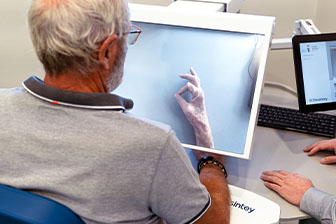
IVS3
- Visuomotor simulation
- Body awareness and action preparation
- Proximal and distal training
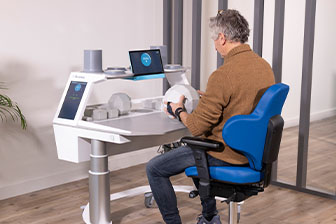
STIIMP
- Reinforcement and reward of the paretic arm usage
- Smart and connected objects
- Intensive uni- and bimanual activities
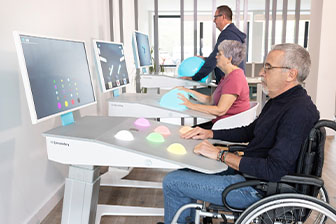
SRT Lab
- Increasing patients’ activity dose
- Rich and playful environment with cognitive and motor activities
- In autonomy or in group therapy
Motor Execution
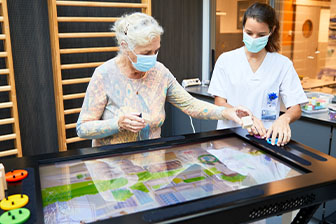
REAtouch
- Interactive & playful device
- Based on the HABIT-ILE method
- Intensive uni- & bimanual activities
Motor execution
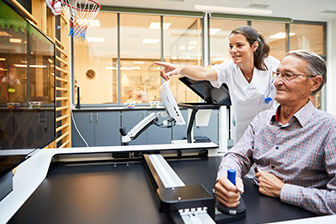
REAplan
- Self-adaptive robotic assistance
- Execution and motor performance
- Proximal work
Triggering
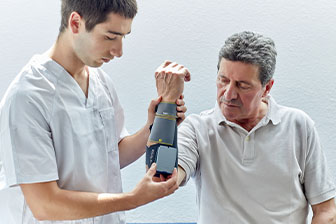
Fesia Grasp
- Functional Electrical Stimulation (FES)
- Improvement of motor control and motor selectivity
- Distal training of the hand and wrist
GAIT LAB
Care continuum for lower limb rehabilitation
Action Planning
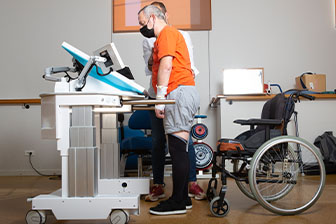
IVS4
- Visuomotor simulation
- Body awareness and action preparation
- Sitting & standing training
Motor execution
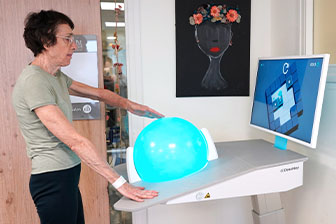
SRT Lab
- Increasing patients’ activity dose
- Rich and playful environment with cognitive and motor activities
- In autonomy or in supervised group therapy
Motor execution
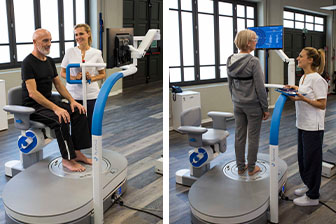
hunova
- Dual robotic platform for sitting and standing
- Balance assessment and rehabilitation
- Sitting & standing training
Triggering
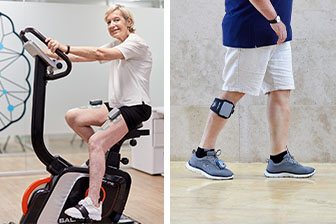
Fesia Bike & Walk
- Functional Electrical Stimulation (FES)
- Improvement of motor control and motor selectivity
- Distal gait training
Motor execution
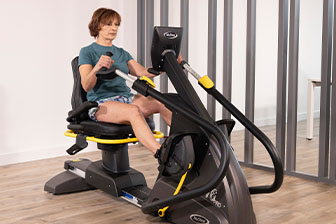
NuStep
- Full-body cardiovascular training
- Low-impact gentle muscle strengthening
- Ergonomic and easy to access